前言
本文只记录一下在搭建科学服务器的配置,对应的海外服务器地址购买推荐使用 Vultr,本文也是基于 Vultr 的 Ubuntu 服务器进行搭建,版本为 20.04 x64,地区推荐日本,因为离我们比较近,网速比较快
注意
科学上网是为了工作、学习、娱乐和提高网络生活质量,请勿违反法律法规,发布违反国家相关法律法规及「九不准」管理规定的信息,如:
- 反对宪法所确定的基本原则危害国家安全;
- 泄露国家秘密,颠覆国家政权,破坏国家统一;
- 损害国家荣誉和利益;
- 煽动民族仇恨、民族歧视,破坏民族团结;
- 侮辱、滥用英烈形象,否定英烈事迹,美化粉饰侵略战争行为的;
- 破坏国家宗教政策,宣扬邪教和封建迷信;
- 散布谣言,扰乱社会秩序,破坏社会稳定;
- 宣扬淫秽、色情、赌博、暴力、凶杀、恐怖或者教唆犯罪;
- 煽动非法集会、结社、游行、示威、聚众扰乱社会秩序;
- 诽谤他人,泄露他人隐私,侵害他人合法权益;
- 含有法律、行政法规禁止的其他内容的信息; :::
Vultr
会给你 100 美刀的试用,应该是一个月的有效期,可以多搭建几个梯子来试试哪个比较快,一般国内就是日本的速度比较快了,目前我是使用的日本服务器
安装服务端 Shadowsocks
买完服务器以后就可以通过 SSH 来进行远程登录了,我们直接开始安装服务端 shadowscoks
三行命令,一次输入一行,完成之后输入下一行
wget --no-check-certificate -O shadowsocks-all.sh https://raw.githubusercontent.com/teddysun/shadowsocks_install/master/shadowsocks-all.sh
chmod +x shadowsocks-all.sh
./shadowsocks-all.sh 2>&1 | tee shadowsocks-all.log
注意
注意 由于上面的被和谐失效了,所以更换了安装源
wget --no-check-certificate https://raw.githubusercontent.com/Yuk1n0/Shadowsocks-Install/master/shadowsocks.sh
chmod +x shadowsocks.sh
./shadowsocks.sh 2>&1 | tee shadowsocks.log
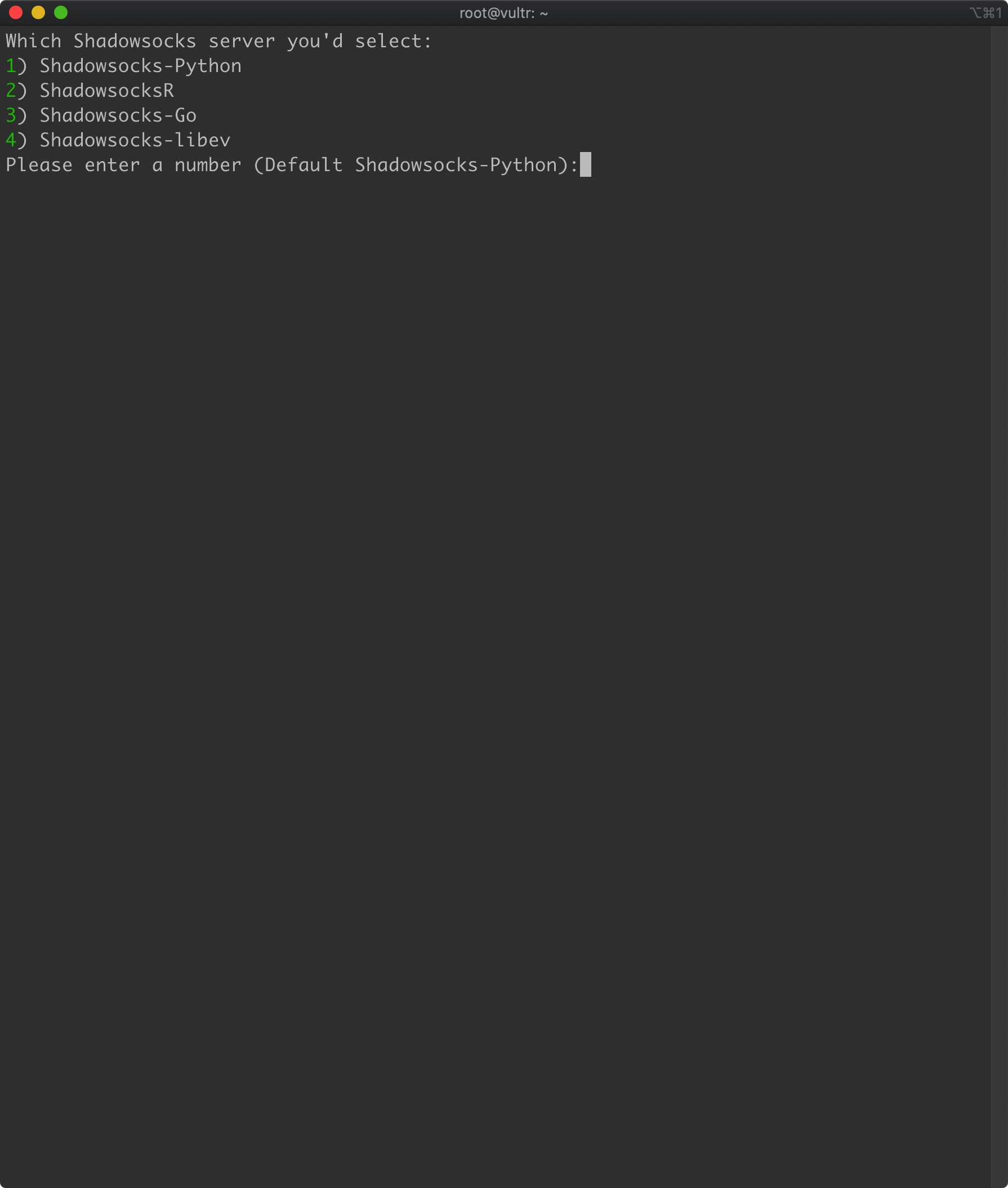
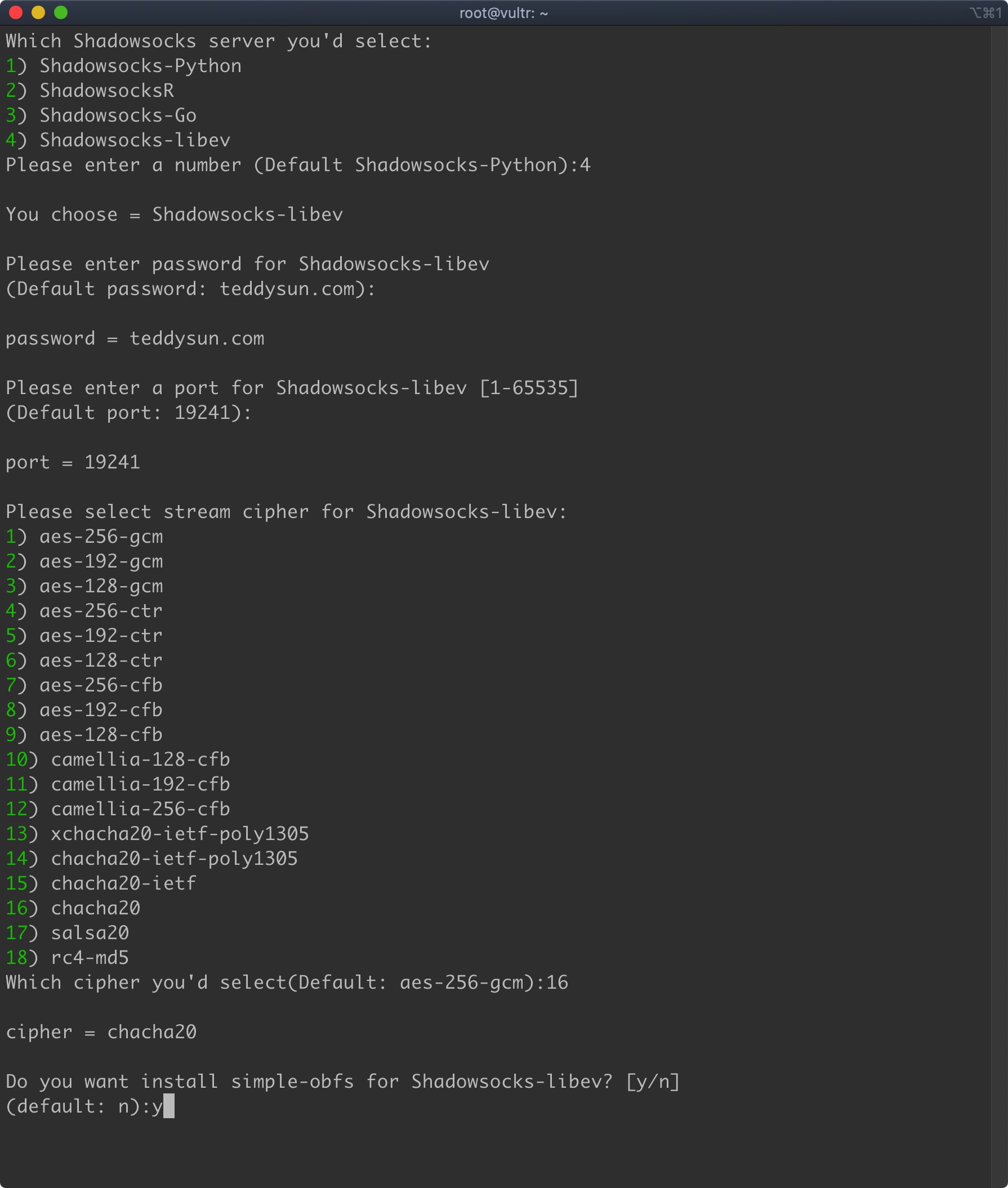
最后一步输完,你应该会看到下图中内容──是要你选择需要安装的Shadowsocks版本。这里选择 4) shadowsocks-libev
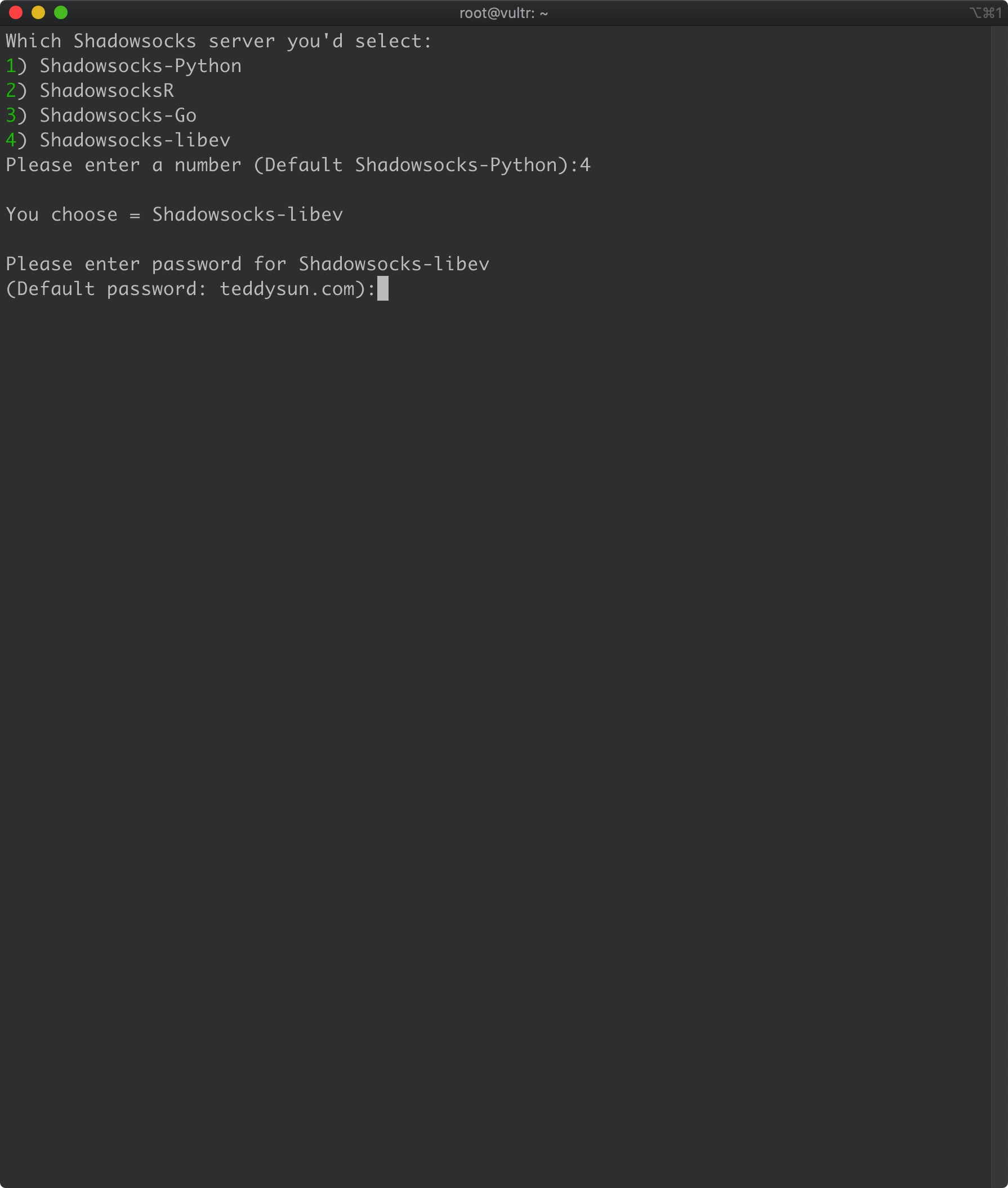
选择完成后会让你输入密码,默认为一个随机密码,你可以回车选择默认,或者自定义一个密码后回车
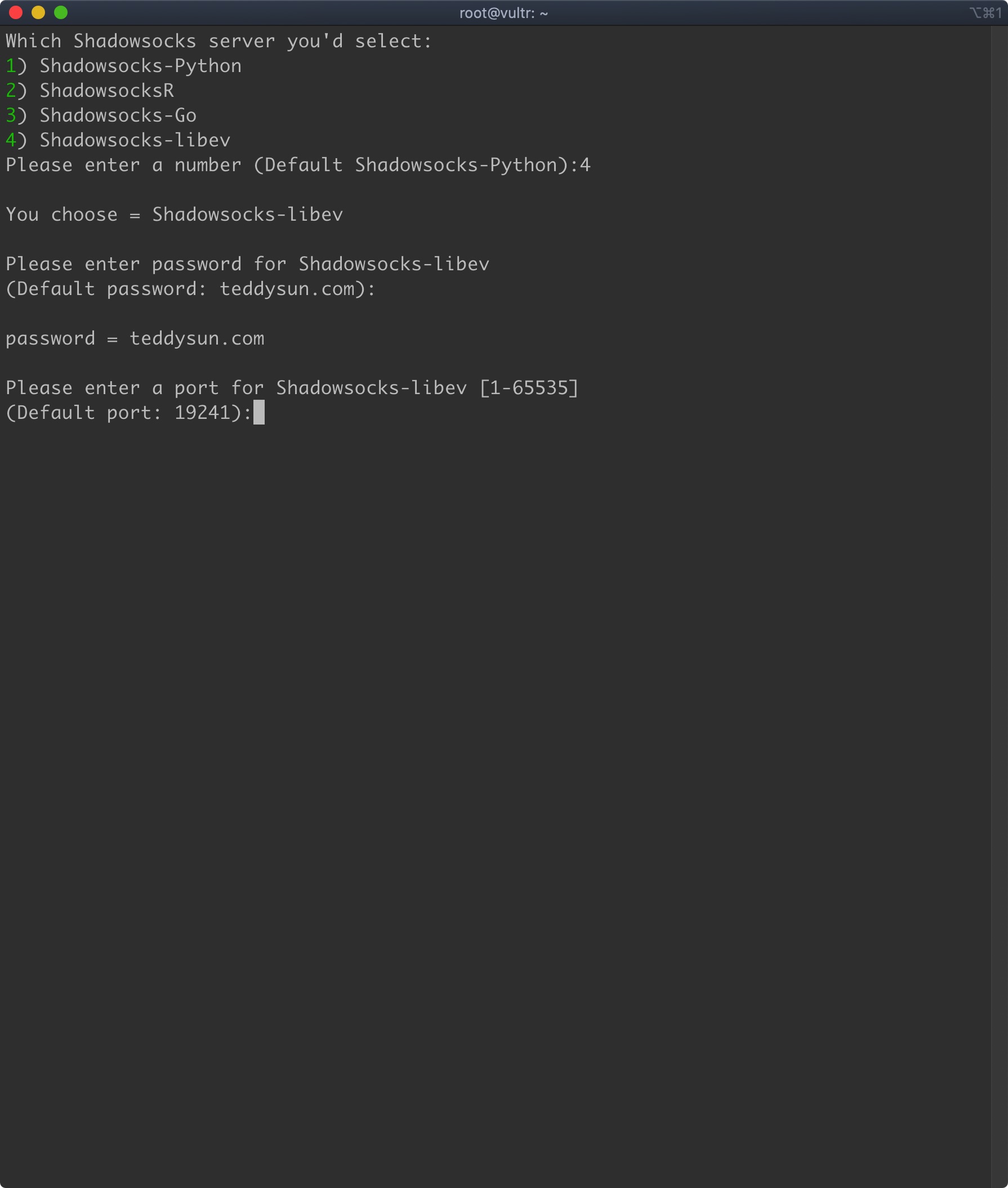
密码设置完成后会让你输入一个端口号,默认随机一个,你也可以自定义一个端口号后回车生成
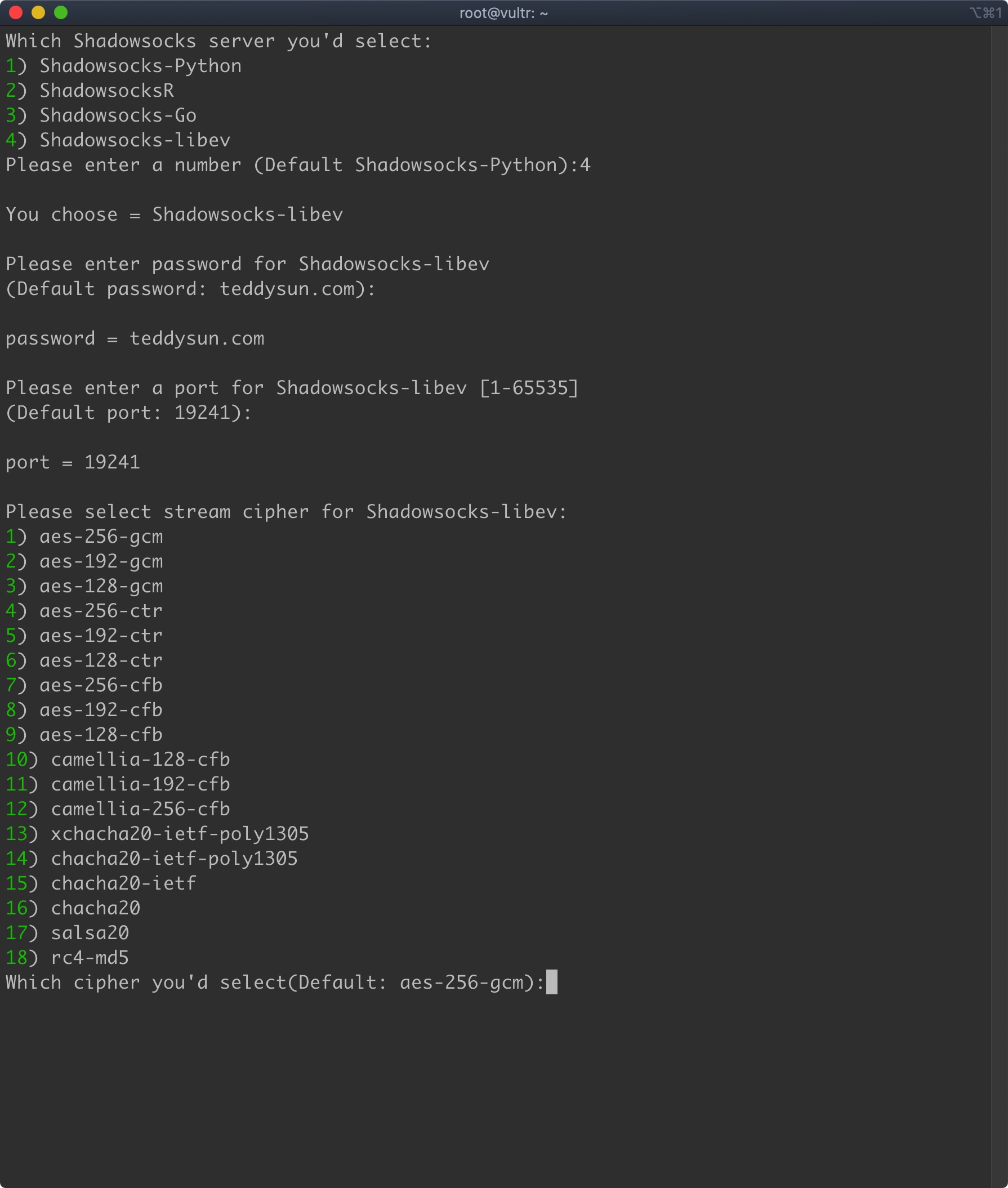
端口号设置完成后,选择一个加密方式,我一般采用 chacha20 来作为加密方式,手机上也是有这个模式的,比较方便,你也可以根据自己的喜好来选择不同的加密方式
设置完成后,会提示你是否需要安装 simple-obfs。这是 ss 的一个插件工具,可以起到混淆的作用,防止IP和端口被嗅探到,建议选 y 安装。
如果上一步选择了 y ,这里可以选择一种混淆方式。通常 TLS 要比 HTTP 的混淆效果更好,所以选 TLS
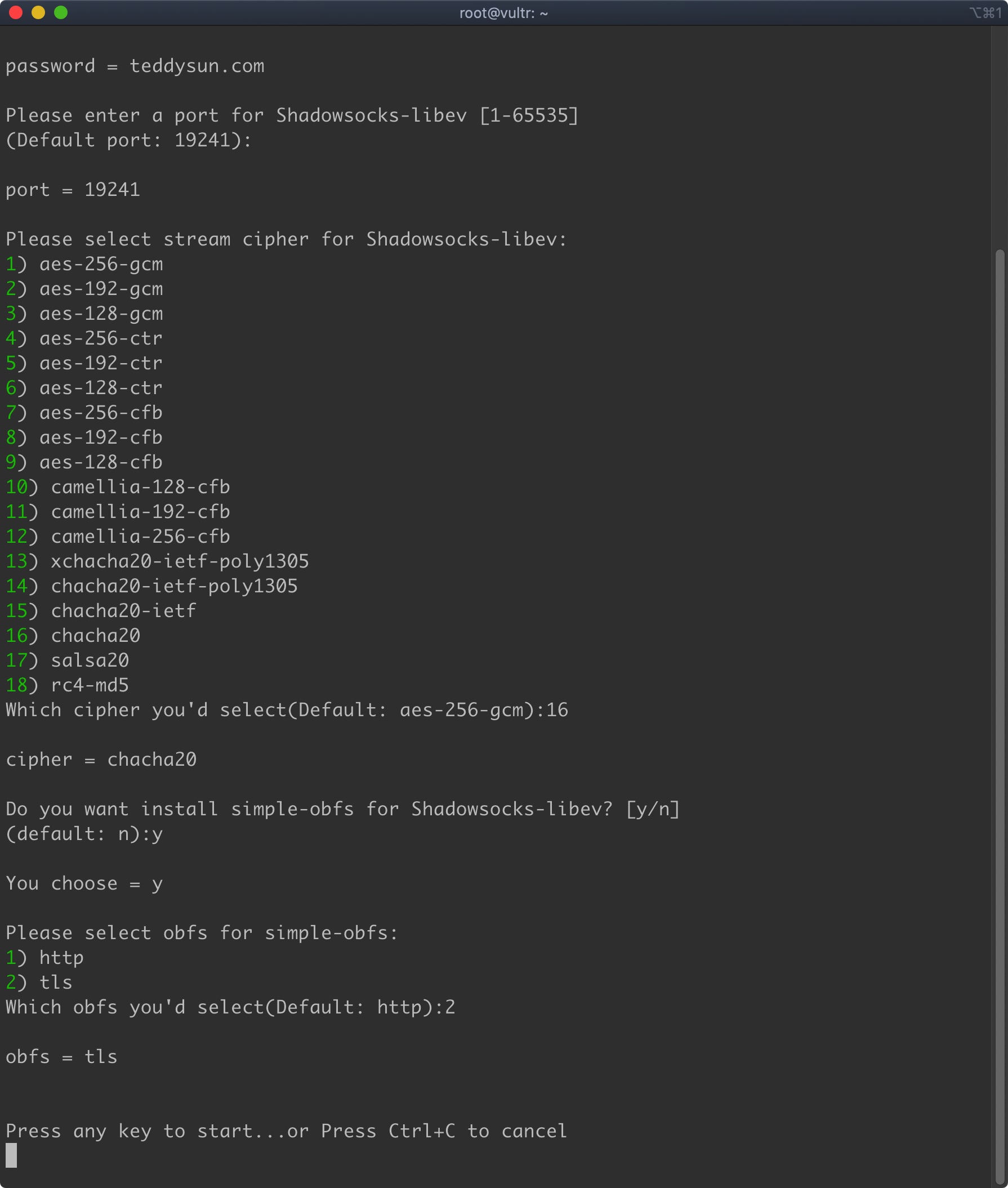
之后就耐心等待安装完成吧,安装完成后会给出你设置的密码、端口、服务器信息配置等,大功告成
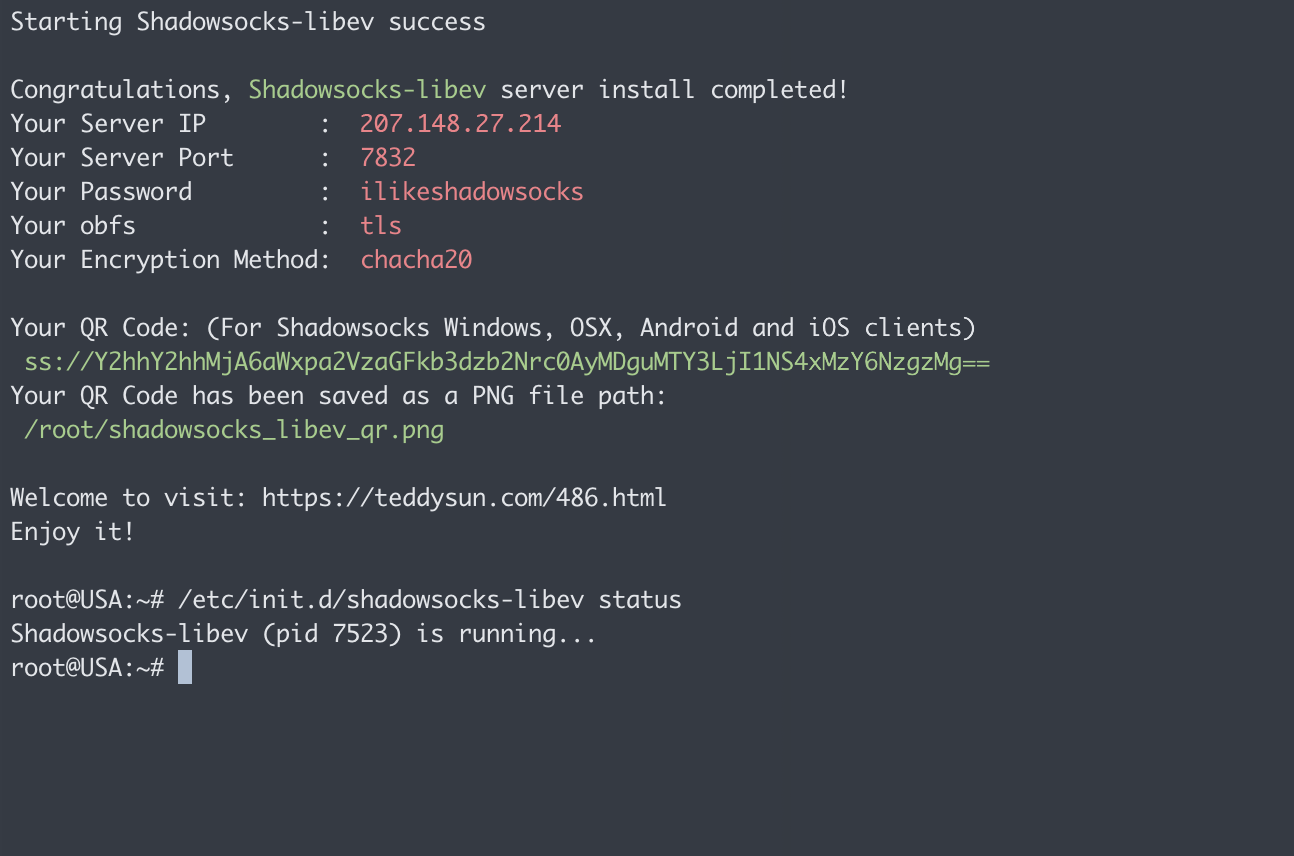
记住红色的内容,也就是服务器IP、服务器ss端口、你设的密码、混淆方式和加密方式。
检查和配置 Shadowsocks
查看是否开始运行
/etc/init.d/shadowsocks-libev status
如果出现类似 Shadowsocks-libev is running... 的字样,说明已经开始正常运行了。
修改相关配置
vim /etc/shadowsocks-libev/config.json
暴露端口
如果此时还是无法通过客户端连接的话,可能是服务器端口未对外开放
如果是类似阿里云,腾讯云的服务器,也还需要在设置里面将端口放开
- 添加指定需要开放的端口
firewall-cmd --add-port=8091/tcp --permanent
- 重载入添加的端口
firewall-cmd --reload
- 查询指定端口是否开启成功
firewall-cmd --query-port=8091/tcp
安装客户端 Shadowsocks
相比服务器端的安装,客户端的安装就简单了许多。首先,在这个页面找到并下载自己操作系统对应的客户端。
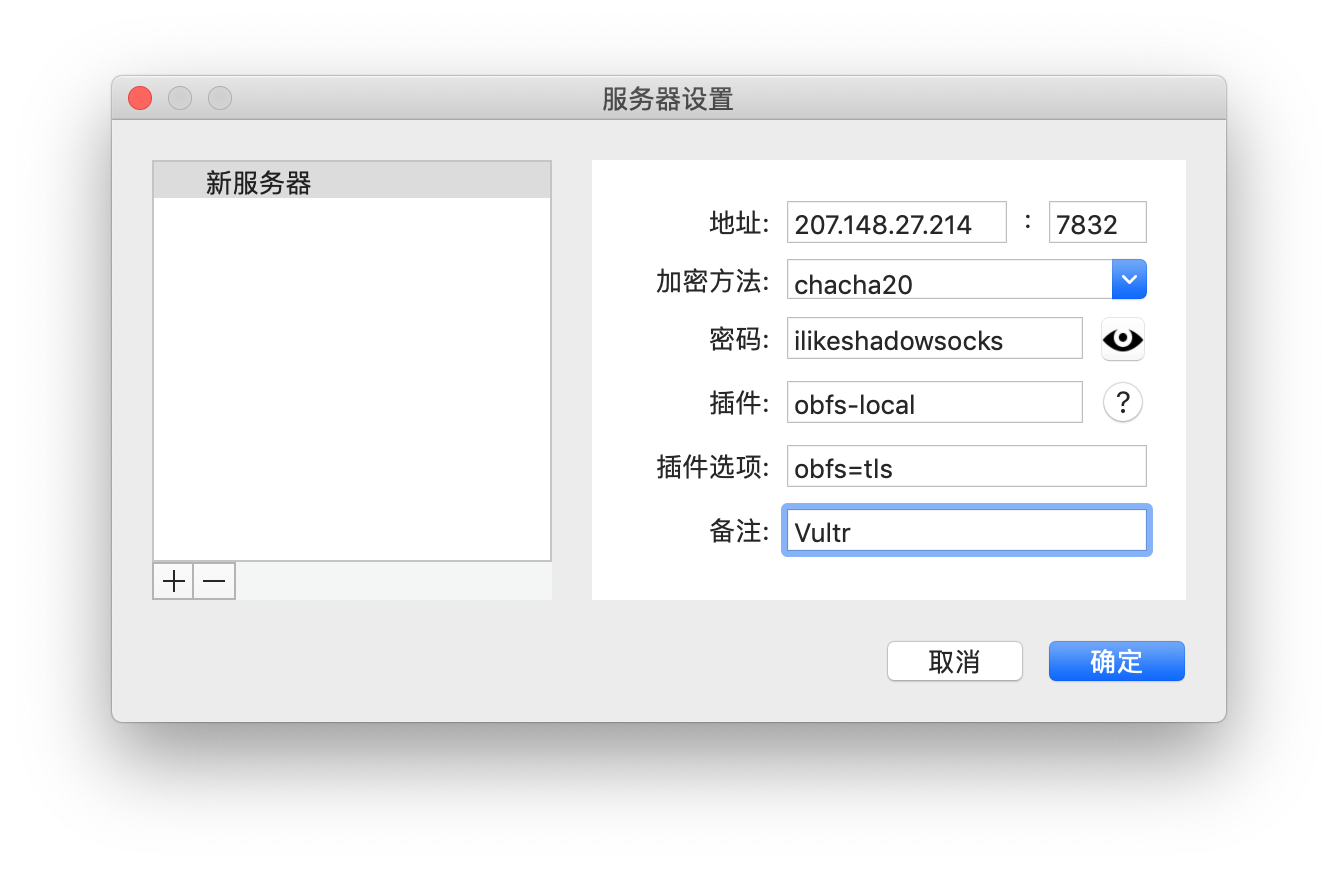
打开客户端,在「服务器设定」里新增服务器。然后依次填入服务器IP、服务器端口、你设的密码和加密方式。
开启 BBR 加速
一键安装脚本
wget --no-check-certificate https://github.com/teddysun/across/raw/master/bbr.sh && chmod +x bbr.sh && ./bbr.sh
完成后根据提示重启,如果没有则不需要,查看是否正在运行
uname -r
lsmod | grep bbr
至此就安装好了 Shadowsocks,可以愉快的学习了~
::: success 解决高版本不支持 python 安装的问题,因为高版本不识别 python 了,都是使用 python3 :::
#!/usr/bin/env bash
PATH=/bin:/sbin:/usr/bin:/usr/sbin:/usr/local/bin:/usr/local/sbin:~/bin
export PATH
#
# Thanks to: Teddysun, M3chD09
# Distributed under the GPLv3 software license, see the accompanying
# file COPYING or https://opensource.org/licenses/GPL-3.0.
#
# Auto install Shadowsocks Server
# System Required: CentOS 6+, Debian7+, Ubuntu12+
#
# Reference URL:
# https://github.com/shadowsocks
# https://github.com/shadowsocks/shadowsocks-libev
# https://github.com/shadowsocksrr/shadowsocksr
#
red='\033[0;31m'
green='\033[0;32m'
yellow='\033[0;33m'
plain='\033[0m'
[[ $EUID -ne 0 ]] && echo -e "[${red}Error${plain}] This script must be run as root!" && exit 1
cur_dir=$(pwd)
software=(Shadowsocks-libev ShadowsocksR)
libsodium_file='libsodium-1.0.18'
libsodium_url='https://github.com/jedisct1/libsodium/releases/download/1.0.18-RELEASE/libsodium-1.0.18.tar.gz'
mbedtls_file='mbedtls-2.16.11'
mbedtls_url='https://github.com/ARMmbed/mbedtls/archive/'"$mbedtls_file"'.tar.gz'
shadowsocks_libev_init="/etc/init.d/shadowsocks-libev"
shadowsocks_libev_config="/etc/shadowsocks-libev/config.json"
shadowsocks_libev_centos="https://raw.githubusercontent.com/Yuk1n0/Shadowsocks-Install/master/shadowsocks-libev-centos"
shadowsocks_libev_debian="https://raw.githubusercontent.com/Yuk1n0/Shadowsocks-Install/master/shadowsocks-libev-debian"
shadowsocks_r_file="shadowsocksr-3.2.2"
shadowsocks_r_url="https://github.com/shadowsocksrr/shadowsocksr/archive/3.2.2.tar.gz"
shadowsocks_r_init="/etc/init.d/shadowsocks-r"
shadowsocks_r_config="/etc/shadowsocks-r/config.json"
shadowsocks_r_centos="https://raw.githubusercontent.com/Yuk1n0/Shadowsocks-Install/master/shadowsocksR-centos"
shadowsocks_r_debian="https://raw.githubusercontent.com/Yuk1n0/Shadowsocks-Install/master/shadowsocksR-debian"
common_ciphers=(
aes-256-gcm
aes-192-gcm
aes-128-gcm
aes-256-cfb
aes-192-cfb
aes-128-cfb
aes-256-ctr
aes-192-ctr
aes-128-ctr
camellia-256-cfb
camellia-192-cfb
camellia-128-cfb
xchacha20-ietf-poly1305
chacha20-ietf-poly1305
chacha20-ietf
chacha20
salsa20
bf-cfb
rc4-md5
)
r_ciphers=(
none
aes-256-cfb
aes-192-cfb
aes-128-cfb
aes-256-cfb8
aes-192-cfb8
aes-128-cfb8
aes-256-ctr
aes-192-ctr
aes-128-ctr
chacha20-ietf
xchacha20
xsalsa20
chacha20
salsa20
rc4-md5
)
# Reference URL:
# https://github.com/shadowsocksrr/shadowsocks-rss/blob/master/ssr.md
# https://github.com/shadowsocksrr/shadowsocksr/commit/a3cf0254508992b7126ab1151df0c2f10bf82680
protocols=(
origin
verify_deflate
auth_sha1_v4
auth_sha1_v4_compatible
auth_aes128_md5
auth_aes128_sha1
auth_chain_a
auth_chain_b
auth_chain_c
auth_chain_d
auth_chain_e
auth_chain_f
)
obfs=(
plain
http_simple
http_simple_compatible
http_post
http_post_compatible
random_head
random_head_compatible
tls1.2_ticket_auth
tls1.2_ticket_auth_compatible
tls1.2_ticket_fastauth
tls1.2_ticket_fastauth_compatible
)
disable_selinux() {
if [ -s /etc/selinux/config ] && grep 'SELINUX=enforcing' /etc/selinux/config; then
sed -i 's/SELINUX=enforcing/SELINUX=disabled/g' /etc/selinux/config
setenforce 0
fi
}
check_sys() {
local checkType=$1
local value=$2
local release=''
local systemPackage=''
if [[ -f /etc/redhat-release ]]; then
release="centos"
systemPackage="yum"
elif grep -Eqi "centos|red hat|redhat" /etc/issue; then
release="centos"
systemPackage="yum"
elif grep -Eqi "centos|red hat|redhat" /proc/version; then
release="centos"
systemPackage="yum"
elif grep -Eqi "debian|raspbian" /etc/issue; then
release="debian"
systemPackage="apt"
elif grep -Eqi "debian|raspbian" /proc/version; then
release="debian"
systemPackage="apt"
elif grep -Eqi "ubuntu" /etc/issue; then
release="ubuntu"
systemPackage="apt"
elif grep -Eqi "ubuntu" /proc/version; then
release="ubuntu"
systemPackage="apt"
fi
if [[ "${checkType}" == "sysRelease" ]]; then
if [ "${value}" == "${release}" ]; then
return 0
else
return 1
fi
elif [[ "${checkType}" == "packageManager" ]]; then
if [ "${value}" == "${systemPackage}" ]; then
return 0
else
return 1
fi
fi
}
# centosversion
getversion() {
if [[ -s /etc/redhat-release ]]; then
grep -oE "[0-9.]+" /etc/redhat-release
else
grep -oE "[0-9.]+" /etc/issue
fi
}
centosversion() {
if check_sys sysRelease centos; then
local code=$1
local version="$(getversion)"
local main_ver=${version%%.*}
if [ "$main_ver" == "$code" ]; then
return 0
else
return 1
fi
else
return 1
fi
}
# debianversion
get_opsy() {
[ -f /etc/redhat-release ] && awk '{print ($1,$3~/^[0-9]/?$3:$4)}' /etc/redhat-release && return
[ -f /etc/os-release ] && awk -F'[= "]' '/PRETTY_NAME/{print $3,$4,$5}' /etc/os-release && return
[ -f /etc/lsb-release ] && awk -F'[="]+' '/DESCRIPTION/{print $2}' /etc/lsb-release && return
}
debianversion() {
if check_sys sysRelease debian; then
local version=$(get_opsy)
local code=${1}
local main_ver=$(echo ${version} | sed 's/[^0-9]//g')
if [ "${main_ver}" == "${code}" ]; then
return 0
else
return 1
fi
else
return 1
fi
}
get_ip() {
local IP=$(ip addr | egrep -o '[0-9]{1,3}\.[0-9]{1,3}\.[0-9]{1,3}\.[0-9]{1,3}' | egrep -v "^192\.168|^172\.1[6-9]\.|^172\.2[0-9]\.|^172\.3[0-2]\.|^10\.|^127\.|^255\.|^0\." | head -n 1)
[ -z ${IP} ] && IP=$(wget -qO- -t1 -T2 ipv4.icanhazip.com)
[ -z ${IP} ] && IP=$(wget -qO- -t1 -T2 ipinfo.io/ip)
echo ${IP}
}
get_ipv6() {
local ipv6=$(wget -qO- -t1 -T2 ipv6.icanhazip.com)
[ -z ${ipv6} ] && return 1 || return 0
}
get_libev_ver() {
libev_ver=$(wget --no-check-certificate -qO- https://api.github.com/repos/shadowsocks/shadowsocks-libev/releases/latest | grep 'tag_name' | cut -d\" -f4)
[ -z ${libev_ver} ] && echo -e "[${red}Error${plain}] Get shadowsocks-libev latest version failed" && exit 1
}
install_check() {
if check_sys packageManager yum || check_sys packageManager apt; then
if centosversion 5; then
return 1
fi
return 0
else
return 1
fi
}
install_select() {
if ! install_check; then
echo -e "[${red}Error${plain}] Your OS is not supported to run it!"
echo "Please change to CentOS 6+/Debian 7+/Ubuntu 12+ and try again."
exit 1
fi
clear
get_libev_ver
while true; do
echo "Which Shadowsocks server you'd select:"
for ((i = 1; i <= ${#software[@]}; i++)); do
hint="${software[$i - 1]}"
echo -e "${green}${i}${plain}) ${hint}"
done
read -p "Please enter a number (Default ${software[0]}):" selected
[ -z "${selected}" ] && selected="1"
case "${selected}" in
1 | 2)
echo
echo "You choose = ${software[${selected} - 1]}"
if [ "${selected}" == "1" ]; then
echo -e "[${green}Info${plain}] Shadowsocks-libev Version: ${libev_ver}"
fi
echo
break
;;
*)
echo -e "[${red}Error${plain}] Please only enter a number [1-2]"
;;
esac
done
}
error_detect_depends() {
local command=$1
local depend=$(echo "${command}" | awk '{print $4}')
echo -e "[${green}Info${plain}] Starting to install package ${depend}"
${command} >/dev/null 2>&1
if [ $? -ne 0 ]; then
echo -e "[${red}Error${plain}] Failed to install ${red}${depend}${plain}"
exit 1
fi
}
install_dependencies() {
if check_sys packageManager yum; then
echo -e "[${green}Info${plain}] Checking the EPEL repository..."
if [ ! -f /etc/yum.repos.d/epel.repo ]; then
yum install -y epel-release >/dev/null 2>&1
fi
[ ! -f /etc/yum.repos.d/epel.repo ] && echo -e "[${red}Error${plain}] Install EPEL repository failed, please check it." && exit 1
[ ! "$(command -v yum-config-manager)" ] && yum install -y yum-utils >/dev/null 2>&1
[ x"$(yum-config-manager epel | grep -w enabled | awk '{print $3}')" != x"True" ] && yum-config-manager --enable epel >/dev/null 2>&1
echo -e "[${green}Info${plain}] Checking the EPEL repository complete..."
yum_depends=(
autoconf automake cpio curl curl-devel gcc git gzip libevent libev-devel libtool make openssl
openssl-devel pcre pcre-devel perl perl-devel python3 python3-devel python3-setuptools
qrencode unzip c-ares-devel expat-devel gettext-devel zlib-devel
)
for depend in ${yum_depends[@]}; do
error_detect_depends "yum -y install ${depend}"
done
elif check_sys packageManager apt; then
apt_depends=(
autoconf automake build-essential cpio curl gcc gettext git gzip libpcre3 libpcre3-dev
libtool make openssl perl python3 python3-dev python3-setuptools qrencode unzip
libc-ares-dev libev-dev libssl-dev zlib1g-dev
)
apt -y update >/dev/null 2>&1
for depend in ${apt_depends[@]}; do
error_detect_depends "apt -y install ${depend}"
done
fi
}
install_prepare_password() {
echo "Please enter password for ${software[${selected} - 1]}"
read -p "(Default password: shadowsocks):" shadowsockspwd
[ -z "${shadowsockspwd}" ] && shadowsockspwd="shadowsocks"
echo
echo "password = ${shadowsockspwd}"
echo
}
install_prepare_port() {
while true; do
dport=$(shuf -i 9000-19999 -n 1)
echo -e "Please enter a port for ${software[${selected} - 1]} [1-65535]"
read -p "(Default port: ${dport}):" shadowsocksport
[ -z "${shadowsocksport}" ] && shadowsocksport=${dport}
expr ${shadowsocksport} + 1 &>/dev/null
if [ $? -eq 0 ]; then
if [ ${shadowsocksport} -ge 1 ] && [ ${shadowsocksport} -le 65535 ] && [ ${shadowsocksport:0:1} != 0 ]; then
echo
echo "port = ${shadowsocksport}"
echo
break
fi
fi
echo -e "[${red}Error${plain}] Please enter a correct number [1-65535]"
done
}
install_prepare_cipher() {
while true; do
echo -e "Please select stream cipher for ${software[${selected} - 1]}:"
if [ "${selected}" == "1" ]; then
for ((i = 1; i <= ${#common_ciphers[@]}; i++)); do
hint="${common_ciphers[$i - 1]}"
echo -e "${green}${i}${plain}) ${hint}"
done
read -p "Which cipher you'd select(Default: ${common_ciphers[0]}):" pick
[ -z "$pick" ] && pick=1
expr ${pick} + 1 &>/dev/null
if [ $? -ne 0 ]; then
echo -e "[${red}Error${plain}] Please enter a number"
continue
fi
if [[ "$pick" -lt 1 || "$pick" -gt ${#common_ciphers[@]} ]]; then
echo -e "[${red}Error${plain}] Please enter a number between 1 and ${#common_ciphers[@]}"
continue
fi
shadowsockscipher=${common_ciphers[$pick - 1]}
elif [ "${selected}" == "2" ]; then
for ((i = 1; i <= ${#r_ciphers[@]}; i++)); do
hint="${r_ciphers[$i - 1]}"
echo -e "${green}${i}${plain}) ${hint}"
done
read -p "Which cipher you'd select(Default: ${r_ciphers[1]}):" pick
[ -z "$pick" ] && pick=2
expr ${pick} + 1 &>/dev/null
if [ $? -ne 0 ]; then
echo -e "[${red}Error${plain}] Please enter a number"
continue
fi
if [[ "$pick" -lt 1 || "$pick" -gt ${#r_ciphers[@]} ]]; then
echo -e "[${red}Error${plain}] Please enter a number between 1 and ${#r_ciphers[@]}"
continue
fi
shadowsockscipher=${r_ciphers[$pick - 1]}
fi
echo
echo "cipher = ${shadowsockscipher}"
echo
break
done
}
install_prepare_protocol() {
while true; do
echo -e "Please select protocol for ${software[${selected} - 1]}:"
for ((i = 1; i <= ${#protocols[@]}; i++)); do
hint="${protocols[$i - 1]}"
echo -e "${green}${i}${plain}) ${hint}"
done
read -p "Which protocol you'd select(Default: ${protocols[0]}):" protocol
[ -z "$protocol" ] && protocol=1
expr ${protocol} + 1 &>/dev/null
if [ $? -ne 0 ]; then
echo -e "[${red}Error${plain}] Please enter a number"
continue
fi
if [[ "$protocol" -lt 1 || "$protocol" -gt ${#protocols[@]} ]]; then
echo -e "[${red}Error${plain}] Please enter a number between 1 and ${#protocols[@]}"
continue
fi
shadowsockprotocol=${protocols[$protocol - 1]}
echo
echo "protocol = ${shadowsockprotocol}"
echo
break
done
}
install_prepare_obfs() {
while true; do
echo -e "Please select obfs for ${software[${selected} - 1]}:"
for ((i = 1; i <= ${#obfs[@]}; i++)); do
hint="${obfs[$i - 1]}"
echo -e "${green}${i}${plain}) ${hint}"
done
read -p "Which obfs you'd select(Default: ${obfs[0]}):" r_obfs
[ -z "$r_obfs" ] && r_obfs=1
expr ${r_obfs} + 1 &>/dev/null
if [ $? -ne 0 ]; then
echo -e "[${red}Error${plain}] Please enter a number"
continue
fi
if [[ "$r_obfs" -lt 1 || "$r_obfs" -gt ${#obfs[@]} ]]; then
echo -e "[${red}Error${plain}] Please enter a number between 1 and ${#obfs[@]}"
continue
fi
shadowsockobfs=${obfs[$r_obfs - 1]}
echo
echo "obfs = ${shadowsockobfs}"
echo
break
done
}
get_char() {
SAVEDSTTY=$(stty -g)
stty -echo
stty cbreak
dd if=/dev/tty bs=1 count=1 2>/dev/null
stty -raw
stty echo
stty $SAVEDSTTY
}
install_prepare() {
if [ "${selected}" == "1" ]; then
install_prepare_password
install_prepare_port
install_prepare_cipher
elif [ "${selected}" == "2" ]; then
install_prepare_password
install_prepare_port
install_prepare_cipher
install_prepare_protocol
install_prepare_obfs
fi
echo "Press any key to start...or Press Ctrl+C to cancel"
char=$(get_char)
}
config_shadowsocks() {
if [ "${selected}" == "1" ]; then
local server_value="\"0.0.0.0\""
if get_ipv6; then
server_value="[\"[::0]\",\"0.0.0.0\"]"
fi
if [ ! -d "$(dirname ${shadowsocks_libev_config})" ]; then
mkdir -p $(dirname ${shadowsocks_libev_config})
fi
cat >${shadowsocks_libev_config} <<-EOF
{
"server":${server_value},
"server_port":${shadowsocksport},
"password":"${shadowsockspwd}",
"method":"${shadowsockscipher}",
"timeout":300,
"user":"nobody",
"fast_open":false
}
EOF
elif [ "${selected}" == "2" ]; then
if [ ! -d "$(dirname ${shadowsocks_r_config})" ]; then
mkdir -p $(dirname ${shadowsocks_r_config})
fi
cat >${shadowsocks_r_config} <<-EOF
{
"server":"0.0.0.0",
"server_ipv6":"::",
"server_port":${shadowsocksport},
"local_address":"127.0.0.1",
"local_port":1080,
"password":"${shadowsockspwd}",
"method":"${shadowsockscipher}",
"protocol":"${shadowsockprotocol}",
"protocol_param":"",
"obfs":"${shadowsockobfs}",
"obfs_param":"",
"timeout":120,
"redirect":"",
"dns_ipv6":false,
"fast_open":false
}
EOF
fi
}
download() {
local filename=$(basename $1)
if [ -f ${1} ]; then
echo "${filename} [found]"
else
echo "${filename} not found, download now..."
wget --no-check-certificate -c -t3 -T60 -O ${1} ${2} >/dev/null 2>&1
if [ $? -ne 0 ]; then
echo -e "[${red}Error${plain}] Download ${filename} failed."
exit 1
fi
fi
}
download_files() {
echo
cd ${cur_dir} || exit
if [ "${selected}" == "1" ]; then
get_libev_ver
shadowsocks_libev_file="shadowsocks-libev-$(echo ${libev_ver} | sed -e 's/^[a-zA-Z]//g')"
shadowsocks_libev_url="https://github.com/shadowsocks/shadowsocks-libev/releases/download/${libev_ver}/${shadowsocks_libev_file}.tar.gz"
download "${shadowsocks_libev_file}.tar.gz" "${shadowsocks_libev_url}"
if check_sys packageManager yum; then
download "${shadowsocks_libev_init}" "${shadowsocks_libev_centos}"
elif check_sys packageManager apt; then
download "${shadowsocks_libev_init}" "${shadowsocks_libev_debian}"
fi
elif [ "${selected}" == "2" ]; then
download "${shadowsocks_r_file}.tar.gz" "${shadowsocks_r_url}"
if check_sys packageManager yum; then
download "${shadowsocks_r_init}" "${shadowsocks_r_centos}"
elif check_sys packageManager apt; then
download "${shadowsocks_r_init}" "${shadowsocks_r_debian}"
fi
fi
}
config_firewall() {
if centosversion 6; then
/etc/init.d/iptables status >/dev/null 2>&1
if [ $? -eq 0 ]; then
iptables -L -n | grep -i ${shadowsocksport} >/dev/null 2>&1
if [ $? -ne 0 ]; then
iptables -I INPUT -m state --state NEW -m tcp -p tcp --dport ${shadowsocksport} -j ACCEPT
iptables -I INPUT -m state --state NEW -m udp -p udp --dport ${shadowsocksport} -j ACCEPT
/etc/init.d/iptables save
/etc/init.d/iptables restart
else
echo
echo -e "[${green}Info${plain}] port ${green}${shadowsocksport}${plain} already be enabled."
fi
else
echo -e "[${yellow}Warning${plain}] iptables looks like not running or not installed, please enable port ${shadowsocksport} manually if necessary."
fi
elif centosversion 7; then
systemctl status firewalld >/dev/null 2>&1
if [ $? -eq 0 ]; then
default_zone=$(firewall-cmd --get-default-zone)
firewall-cmd --permanent --zone=${default_zone} --add-port=${shadowsocksport}/tcp
firewall-cmd --permanent --zone=${default_zone} --add-port=${shadowsocksport}/udp
firewall-cmd --reload
else
echo -e "[${yellow}Warning${plain}] firewalld looks like not running or not installed, please enable port ${shadowsocksport} manually if necessary."
fi
fi
}
install_libsodium() {
if [ -f /usr/lib/libsodium.a ] || [ -f /usr/lib64/libsodium.a ]; then
echo
echo -e "[${green}Info${plain}] ${libsodium_file} already installed."
else
echo
echo -e "[${green}Info${plain}] ${libsodium_file} start installing."
cd ${cur_dir} || exit
download "${libsodium_file}.tar.gz" "${libsodium_url}"
tar zxf ${libsodium_file}.tar.gz
cd ${libsodium_file} || exit
./configure --prefix=/usr && make && make install
if [ $? -ne 0 ]; then
echo -e "[${red}Error${plain}] ${libsodium_file} install failed."
install_cleanup
exit 1
fi
echo -e "[${green}Info${plain}] ${libsodium_file} install success!"
fi
}
install_mbedtls() {
if [ -f /usr/lib/libmbedtls.a ] || [ -f /usr/lib64/libmbedtls.a ]; then
echo
echo -e "[${green}Info${plain}] ${mbedtls_file} already installed."
else
echo
echo -e "[${green}Info${plain}] ${mbedtls_file} start installing."
cd ${cur_dir} || exit
download "mbedtls-${mbedtls_file}.tar.gz" "${mbedtls_url}"
tar zxf mbedtls-${mbedtls_file}.tar.gz
cd mbedtls-${mbedtls_file}
make SHARED=1 CFLAGS=-fPIC
make DESTDIR=/usr install
if [ $? -ne 0 ]; then
echo -e "[${red}Error${plain}] ${mbedtls_file} install failed."
install_cleanup
exit 1
fi
echo -e "[${green}Info${plain}] ${mbedtls_file} install success!"
fi
}
install_shadowsocks_libev() {
if [ -f /usr/local/bin/ss-server ] || [ -f /usr/bin/ss-server ]; then
echo
echo -e "[${green}Info${plain}] ${software[0]} already installed."
else
echo
echo -e "[${green}Info${plain}] ${software[0]} start installing."
cd ${cur_dir} || exit
tar zxf ${shadowsocks_libev_file}.tar.gz
cd ${shadowsocks_libev_file} || exit
./configure --disable-documentation && make && make install
if [ $? -eq 0 ]; then
chmod +x ${shadowsocks_libev_init}
local service_name=$(basename ${shadowsocks_libev_init})
if check_sys packageManager yum; then
chkconfig --add ${service_name}
chkconfig ${service_name} on
elif check_sys packageManager apt; then
update-rc.d -f ${service_name} defaults
fi
else
echo
echo -e "[${red}Error${plain}] ${software[0]} install failed."
install_cleanup
exit 1
fi
fi
}
install_shadowsocks_r() {
if [ -f /usr/local/shadowsocks/server.py ]; then
echo
echo -e "[${green}Info${plain}] ${software[1]} already installed."
else
echo
echo -e "[${green}Info${plain}] ${software[1]} start installing."
cd ${cur_dir} || exit
tar zxf ${shadowsocks_r_file}.tar.gz
mv ${shadowsocks_r_file}/shadowsocks /usr/local/
if [ -f /usr/local/shadowsocks/server.py ]; then
chmod +x ${shadowsocks_r_init}
local service_name=$(basename ${shadowsocks_r_init})
if check_sys packageManager yum; then
chkconfig --add ${service_name}
chkconfig ${service_name} on
elif check_sys packageManager apt; then
update-rc.d -f ${service_name} defaults
fi
else
echo
echo -e "[${red}Error${plain}] ${software[1]} install failed."
install_cleanup
exit 1
fi
fi
}
install_completed_libev() {
clear
ldconfig
${shadowsocks_libev_init} start
echo
echo -e "Congratulations, ${green}${software[0]}${plain} server install completed!"
echo -e "Your Server IP : ${red} $(get_ip) ${plain}"
echo -e "Your Server Port : ${red} ${shadowsocksport} ${plain}"
echo -e "Your Password : ${red} ${shadowsockspwd} ${plain}"
echo -e "Your Encryption Method: ${red} ${shadowsockscipher} ${plain}"
}
install_completed_r() {
clear
${shadowsocks_r_init} start
echo
echo -e "Congratulations, ${green}${software[1]}${plain} server install completed!"
echo -e "Your Server IP : ${red} $(get_ip) ${plain}"
echo -e "Your Server Port : ${red} ${shadowsocksport} ${plain}"
echo -e "Your Password : ${red} ${shadowsockspwd} ${plain}"
echo -e "Your Protocol : ${red} ${shadowsockprotocol} ${plain}"
echo -e "Your obfs : ${red} ${shadowsockobfs} ${plain}"
echo -e "Your Encryption Method: ${red} ${shadowsockscipher} ${plain}"
}
qr_generate_libev() {
if [ "$(command -v qrencode)" ]; then
local tmp=$(echo -n "${shadowsockscipher}:${shadowsockspwd}@$(get_ip):${shadowsocksport}" | base64 -w0)
local qr_code="ss://${tmp}"
echo
echo "Your QR Code: (For Shadowsocks Windows, OSX, Android and iOS clients)"
echo -e "${green} ${qr_code} ${plain}"
echo -n "${qr_code}" | qrencode -s8 -o ${cur_dir}/shadowsocks_libev_qr.png
echo "Your QR Code has been saved as a PNG file path:"
echo -e "${green} ${cur_dir}/shadowsocks_libev_qr.png ${plain}"
fi
}
qr_generate_r() {
if [ "$(command -v qrencode)" ]; then
local tmp1=$(echo -n "${shadowsockspwd}" | base64 -w0 | sed 's/=//g;s/\//_/g;s/+/-/g')
local tmp2=$(echo -n "$(get_ip):${shadowsocksport}:${shadowsockprotocol}:${shadowsockscipher}:${shadowsockobfs}:${tmp1}/?obfsparam=" | base64 -w0)
local qr_code="ssr://${tmp2}"
echo
echo "Your QR Code: (For ShadowsocksR Windows, Android clients only)"
echo -e "${green} ${qr_code} ${plain}"
echo -n "${qr_code}" | qrencode -s8 -o ${cur_dir}/shadowsocks_r_qr.png
echo "Your QR Code has been saved as a PNG file path:"
echo -e "${green} ${cur_dir}/shadowsocks_r_qr.png ${plain}"
fi
}
install_main() {
install_libsodium
if ! ldconfig -p | grep -wq "/usr/lib"; then
echo "/usr/lib" >/etc/ld.so.conf.d/lib.conf
fi
if ! ldconfig -p | grep -wq "/usr/lib64"; then
echo "/usr/lib64" >>/etc/ld.so.conf.d/lib.conf
fi
ldconfig
if [ "${selected}" == "1" ]; then
install_mbedtls
ldconfig
install_shadowsocks_libev
install_completed_libev
qr_generate_libev
elif [ "${selected}" == "2" ]; then
install_shadowsocks_r
install_completed_r
qr_generate_r
fi
echo
echo "Enjoy it!"
echo
}
install_cleanup() {
cd ${cur_dir} || exit
rm -rf ${libsodium_file} ${libsodium_file}.tar.gz
rm -rf mbedtls-${mbedtls_file} mbedtls-${mbedtls_file}.tar.gz
rm -rf ${shadowsocks_libev_file} ${shadowsocks_libev_file}.tar.gz
rm -rf ${shadowsocks_r_file} ${shadowsocks_r_file}.tar.gz
}
install_shadowsocks() {
disable_selinux
install_select
install_dependencies
install_prepare
config_shadowsocks
download_files
if check_sys packageManager yum; then
config_firewall
fi
install_main
install_cleanup
}
uninstall_libsodium() {
printf "Are you sure uninstall ${red}${libsodium_file}${plain}? [y/n]\n"
read -p "(default: n):" answer
[ -z ${answer} ] && answer="n"
if [ "${answer}" == "y" ] || [ "${answer}" == "Y" ]; then
rm -f /usr/lib64/libsodium.so.23
rm -f /usr/lib64/libsodium.a
rm -f /usr/lib64/libsodium.la
rm -f /usr/lib64/pkgconfig/libsodium.pc
rm -f /usr/lib64/libsodium.so.23.3.0
rm -f /usr/lib64/libsodium.so
rm -rf /usr/include/sodium
rm -f /usr/include/sodium.h
ldconfig
echo -e "[${green}Info${plain}] ${libsodium_file} uninstall success"
else
echo
echo -e "[${green}Info${plain}] ${libsodium_file} uninstall cancelled, nothing to do..."
echo
fi
}
uninstall_mbedtls() {
printf "Are you sure uninstall ${red}${mbedtls_file}${plain}? [y/n]\n"
read -p "(default: n):" answer
[ -z ${answer} ] && answer="n"
if [ "${answer}" == "y" ] || [ "${answer}" == "Y" ]; then
rm -f /usr/lib/libmbedtls.a
rm -f /usr/lib/libmbedtls.so
rm -f /usr/lib/libmbedtls.so.13
rm -rf /usr/include/mbedtls
rm -f /usr/include/mbedtls/mbedtls_config.h
rm -f /usr/bin/mbedtls_*
ldconfig
echo -e "[${green}Info${plain}] ${mbedtls_file} uninstall success"
else
echo
echo -e "[${green}Info${plain}] ${mbedtls_file} uninstall cancelled, nothing to do..."
echo
fi
}
uninstall_shadowsocks_libev() {
printf "Are you sure uninstall ${red}${software[0]}${plain}? [y/n]\n"
read -p "(default: n):" answer
[ -z ${answer} ] && answer="n"
if [ "${answer}" == "y" ] || [ "${answer}" == "Y" ]; then
${shadowsocks_libev_init} status >/dev/null 2>&1
if [ $? -eq 0 ]; then
${shadowsocks_libev_init} stop
fi
local service_name=$(basename ${shadowsocks_libev_init})
if check_sys packageManager yum; then
chkconfig --del ${service_name}
elif check_sys packageManager apt; then
update-rc.d -f ${service_name} remove
fi
rm -f /usr/local/bin/ss-local
rm -f /usr/local/bin/ss-server
rm -f /usr/local/bin/ss-tunnel
rm -f /usr/local/bin/ss-manager
rm -f /usr/local/bin/ss-redir
rm -f /usr/local/bin/ss-nat
rm -f /usr/local/include/shadowsocks.h
rm -f /usr/local/lib/libshadowsocks-libev.a
rm -f /usr/local/lib/libshadowsocks-libev.la
rm -f /usr/local/lib/pkgconfig/shadowsocks-libev.pc
rm -f /usr/local/share/man/man1/ss-local.1
rm -f /usr/local/share/man/man1/ss-server.1
rm -f /usr/local/share/man/man1/ss-tunnel.1
rm -f /usr/local/share/man/man1/ss-manager.1
rm -f /usr/local/share/man/man1/ss-redir.1
rm -f /usr/local/share/man/man1/ss-nat.1
rm -f /usr/local/share/man/man8/shadowsocks-libev.8
rm -rf /usr/local/share/doc/shadowsocks-libev
rm -rf $(dirname ${shadowsocks_libev_config})
rm -f ${shadowsocks_libev_init}
echo -e "[${green}Info${plain}] ${software[0]} uninstall success"
else
echo
echo -e "[${green}Info${plain}] ${software[0]} uninstall cancelled, nothing to do..."
echo
fi
}
uninstall_shadowsocks_r() {
printf "Are you sure uninstall ${red}${software[1]}${plain}? [y/n]\n"
read -p "(default: n):" answer
[ -z ${answer} ] && answer="n"
if [ "${answer}" == "y" ] || [ "${answer}" == "Y" ]; then
${shadowsocks_r_init} status >/dev/null 2>&1
if [ $? -eq 0 ]; then
${shadowsocks_r_init} stop
fi
local service_name=$(basename ${shadowsocks_r_init})
if check_sys packageManager yum; then
chkconfig --del ${service_name}
elif check_sys packageManager apt; then
update-rc.d -f ${service_name} remove
fi
rm -fr $(dirname ${shadowsocks_r_config})
rm -f ${shadowsocks_r_init}
rm -f /var/log/shadowsocks.log
rm -fr /usr/local/shadowsocks
echo -e "[${green}Info${plain}] ${software[1]} uninstall success"
else
echo
echo -e "[${green}Info${plain}] ${software[1]} uninstall cancelled, nothing to do..."
echo
fi
}
uninstall_shadowsocks() {
while true; do
echo "Which Shadowsocks server you want to uninstall?"
for ((i = 1; i <= ${#software[@]}; i++)); do
hint="${software[$i - 1]}"
echo -e "${green}${i}${plain}) ${hint}"
done
read -p "Please enter a number [1-2]:" un_select
case "${un_select}" in
1 | 2)
echo
echo "You choose = ${software[${un_select} - 1]}"
echo
break
;;
*)
echo -e "[${red}Error${plain}] Please only enter a number [1-2]"
;;
esac
done
if [ "${un_select}" == "1" ]; then
if [ -f ${shadowsocks_libev_init} ]; then
uninstall_shadowsocks_libev
else
echo -e "[${red}Error${plain}] ${software[${un_select} - 1]} not installed, please check it and try again."
echo
exit 1
fi
elif [ "${un_select}" == "2" ]; then
if [ -f ${shadowsocks_r_init} ]; then
uninstall_shadowsocks_r
else
echo -e "[${red}Error${plain}] ${software[${un_select} - 1]} not installed, please check it and try again."
echo
exit 1
fi
fi
ldconfig
}
upgrade_shadowsocks() {
clear
echo -e "Upgrade ${green}${software[0]}${plain} ? [y/n]"
read -p "(default: n) : " answer_upgrade
[ -z ${answer_upgrade} ] && answer_upgrade="n"
if [ "${answer_upgrade}" == "Y" ] || [ "${answer_upgrade}" == "y" ]; then
if [ -f ${shadowsocks_r_init} ]; then
echo
echo -e "[${red}Error${plain}] Only support shadowsocks-libev !"
echo
exit 1
elif [ -f ${shadowsocks_libev_init} ]; then
if [ ! "$(command -v ss-server)" ]; then
echo
echo -e "[${red}Error${plain}] Shadowsocks-libev not installed..."
echo
exit 1
else
current_local_version=$(ss-server --help | grep shadowsocks | cut -d' ' -f2)
fi
get_libev_ver
current_libev_ver=$(echo ${libev_ver} | sed -e 's/^[a-zA-Z]//g')
echo
echo -e "[${green}Info${plain}] Shadowsocks-libev Version: v${current_local_version}"
if [[ "${current_libev_ver}" == "${current_local_version}" ]]; then
echo
echo -e "[${green}Info${plain}] Already updated to latest version !"
echo
exit 1
fi
uninstall_shadowsocks_libev
ldconfig
if [ "${answer}" == "Y" ] || [ "${answer}" == "y" ]; then
disable_selinux
selected=1
echo
echo "You will upgrade ${software[${seleted} - 1]}"
echo
shadowsockspwd=$(cat /etc/shadowsocks-libev/config.json | grep password | cut -d\" -f4)
shadowsocksport=$(cat /etc/shadowsocks-libev/config.json | grep server_port | cut -d ',' -f1 | cut -d ':' -f2)
shadowsockscipher=$(cat /etc/shadowsocks-libev/config.json | grep method | cut -d\" -f4)
config_shadowsocks
download_files
install_shadowsocks_libev
install_completed_libev
qr_generate_libev
else
exit 1
fi
else
echo
echo -e "[${red}Error${plain}] Shadowsocks-libev server doesn't exist !"
echo
exit 1
fi
else
echo
echo -e "[${green}Info${plain}] ${software[0]} upgrade cancelled, nothing to do..."
echo
fi
}
# Initialization step
action=$1
[ -z $1 ] && action=install
case "${action}" in
install | uninstall | upgrade)
${action}_shadowsocks
;;
*)
echo "Arguments error! [${action}]"
echo "Usage: $(basename $0) [install|uninstall|upgrade]"
;;
esac
参考链接
科学上网的终极姿势,在Vultr VPS上搭建Shadowsocks: 详细的介绍了原理,搭建,以及对应的解释和额外的一些内容,可以看看